Noon Chai & Sheer Chai
The ancient pink elixir of the Valley of Kashmir
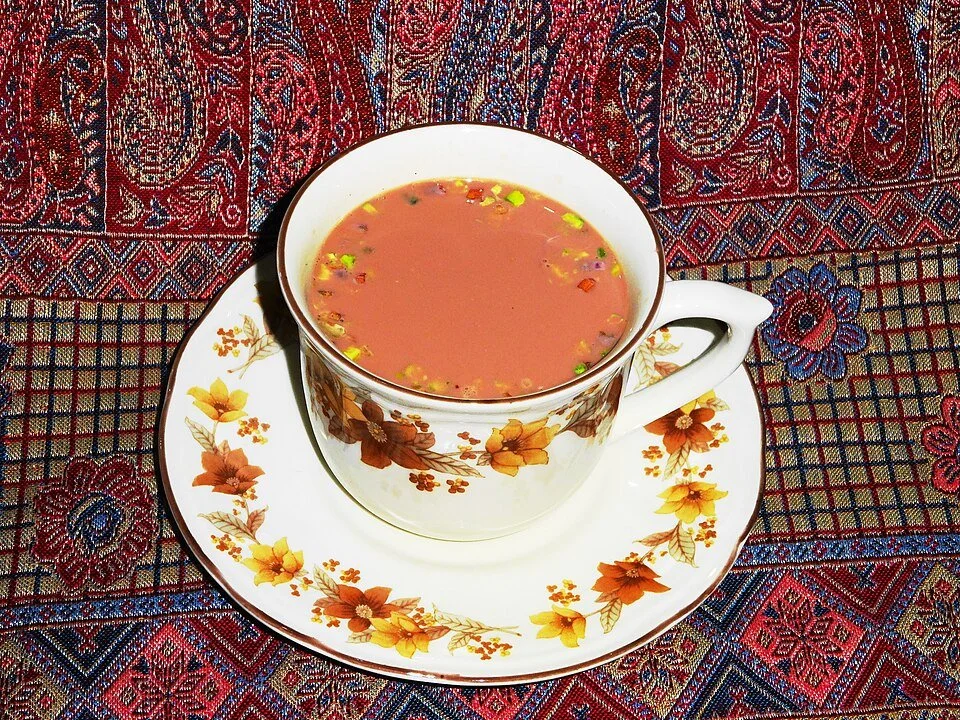
Credit : Wikimedia Commons · CC BY-SA
"In Kashmir, Noon Chai is not merely a drink — it is a ritual of hospitality, a mark of generosity, and a thread that stitches together centuries of culture into a single, blush-pink cup."
Imagine lifting a cup of tea to your lips and finding it pink. Not from rose petals or food dye, but from a centuries-old alchemy of gunpowder tea leaves, baking soda, milk, and salt. This is Noon Chai, also lovingly called Sheer Chai, and it is one of the most singular, complex, and culturally rich beverages on earth.
Unlike the sweet masala chais of South Asia or the delicate green teas of East Asia, Noon Chai is unique in its own kind: salty, buttery, subtly smoky, and warming in a way that only makes sense in the bitter cold of December.
A Tea Unlike Any Other
Noon Chai traces its origins to the ancient Silk Road era and the courts of Kashmir's Sultans
The tea is vigorously splashed and re-boiled to develop its signature blush colour and creamy foam
"Noon" means salt in Kashmiri; "Sheer" means milk in Persian — together they tell the whole story
While it a "daily workhorse" of Kashmiri cuisine, Kashmiri Pandits typically drink it in the afternoon
Origins & History
Born on the Silk Road
The story of Noon Chai begins long before the Kashmir Valley became synonymous with shawls and saffron. Historians trace its roots to Central Asia and the ancient trade routes that connected the Himalayan valley to Persia, Tibet, and the courts of the Mughal emperors. The practice of drinking salted, buttered tea is ancient across the Himalayan arc, from Tibet's po cha (yak butter tea) to Mongolian suutei tsai, and Noon Chai is Kashmir's own magnificent variation on this tradition.
It is believed that the tea arrived in the valley through Kashmiri merchants and traders who traveled the Silk Road routes through Ladakh, Xinjiang, and into Central Asia. The harsh, high-altitude environments demanded calorie-dense, warming beverages and a salted, fat-rich tea was the perfect fuel for both merchants and mountain dwellers alike.
Over centuries, Noon Chai was refined in the kitchens of Kashmiri households, absorbing local ingredients like cardamom, cinnamon, and star anise, and eventually becoming an inseparable part of Kashmiri identity. By the time of the Sultanate of Kashmir (14th–16th centuries), it was already deeply embedded in the social fabric of the valley.
The Alchemy
What Goes Into the Pink
Each ingredient in Noon Chai plays a specific, irreplaceable role; remove one and the magic unravels.
Rolled green tea leaves that create the base : robust and slightly smoky
Whole milk gives the tea its creamy body and helps develop the pink hue
The soul of the drink : salty, mineral, deeply Kashmiri
The secret agent reacts with tea tannins to produce the blush-pink colour
Warmth and fragrance : cardamom, cinnamon, star anise, or clove
Fresh cream and crushed pistachios or almonds to finish
The Fascinating Science
Why Is It Pink?
This is the question every first-time observer asks and the answer is a small miracle of chemistry. When green tea leaves are brewed strongly and then combined with baking soda (sodium bicarbonate), the alkaline environment causes the tea's natural anthocyanin pigments to shift along the pH spectrum, turning the brew from dark olive-green to a vivid, brick-red concentrate.
This deeply coloured liquid is called kawah qand or the "base" in local terminology. When full-fat milk is vigorously splashed and stirred in, a process that aerates and emulsifies the mixture, it dilutes and lightens the red into a dusty, romantic rose-pink. The foam on top picks up the colour most vividly, creating that characteristic blush head of the perfectly made cup.
The traditional technique involves repeatedly ladling the tea from height pouring it back and forth between a pot and a ladle, sometimes dozens of times to incorporate air and develop the colour. This process, called cheeni, requires skill and patience, and experienced cooks can read the colour of the froth to know when the tea is ready.
Culture & Ritual
The Samovar & the Soul of Hospitality
You cannot separate Noon Chai from its vessel: the Samovar, a copper or brass urn with a central charcoal-heated chimney, imported into Kashmir from Russian and Central Asian traditions via Silk Road trade. The samovar is as much a cultural symbol as a practical tool, its presence at a gathering signals warmth, generosity, and welcome.
Traditionally, Noon Chai was made in Samovars, though the practice is waning. At Kashmiri Muslim weddings, Noon Chai is typically served in a distinctive ceremony called wazwan chai, alongside an elaborate bread spread of kulcha, lavasa, sheermal, and baqerkhani, Kashmiri flatbreads that are dipped and dunked into the salty chai.
The Traditional Recipe
How to Make Noon Chai
Making authentic Noon Chai is a labour of love, it cannot be rushed. Here is the traditional method, simplified for a home kitchen.
Did You Know?
Fascinating Facts About Noon Chai
-
It tastes nothing like it looks. First-timers expect something sweet and floral because of the colour but the first sip delivers a savoury, buttery, slightly smoky warmth that is startlingly unique. It takes most outsiders two or three cups before they fall in love with it.
-
It's a cold-weather survival drink. Kashmir's winters can drop to -10°C or below. Noon Chai with its salt, fat, and calories is both warming and genuinely nourishing, historically it was the primary breakfast for many Kashmiri families during winter months.
-
"Sheer Chai" and "Noon Chai" are technically different. Purists argue that Sheer Chai is the richer, sweeter ceremonial version made with more cream and less salt, while Noon Chai is the everyday salty version. In practice, the terms are used interchangeably across Kashmir.
-
It has a diaspora following. Kashmiri communities across Kashmir, the UK, and North America have brought Noon Chai with them and a growing number of specialty tea cafes in cities like London and Toronto now serve it to enthusiastic non-Kashmiri audiences.
-
Instant Noon Chai mix exists and it's controversial. Commercial pink tea premixes are widely sold across Pakistan and India. Kashmiri purists are dismissive ("It tastes like regret," one grandmother reportedly told a food blogger), but the mixes have introduced millions of people to the flavour profile of Noon Chai.
-
It plays a role in Kashmiri poetry and literature. References to sheer chai appear in classical Kashmiri poetry (vakhs and lolas), where the warmth of the cup is often used as a metaphor for love, homecoming, and maternal care.
A Cup of Kashmir in Your Hands
To drink Noon Chai is to hold a piece of the Himalayas — ancient trade routes, royal kitchens, winter fires, and a thousand years of hospitality compressed into a single blush-pink cup. Whether you make it at home or seek it out at a Kashmiri restaurant, let the first salty, creamy, rose-coloured sip take you somewhere far away.